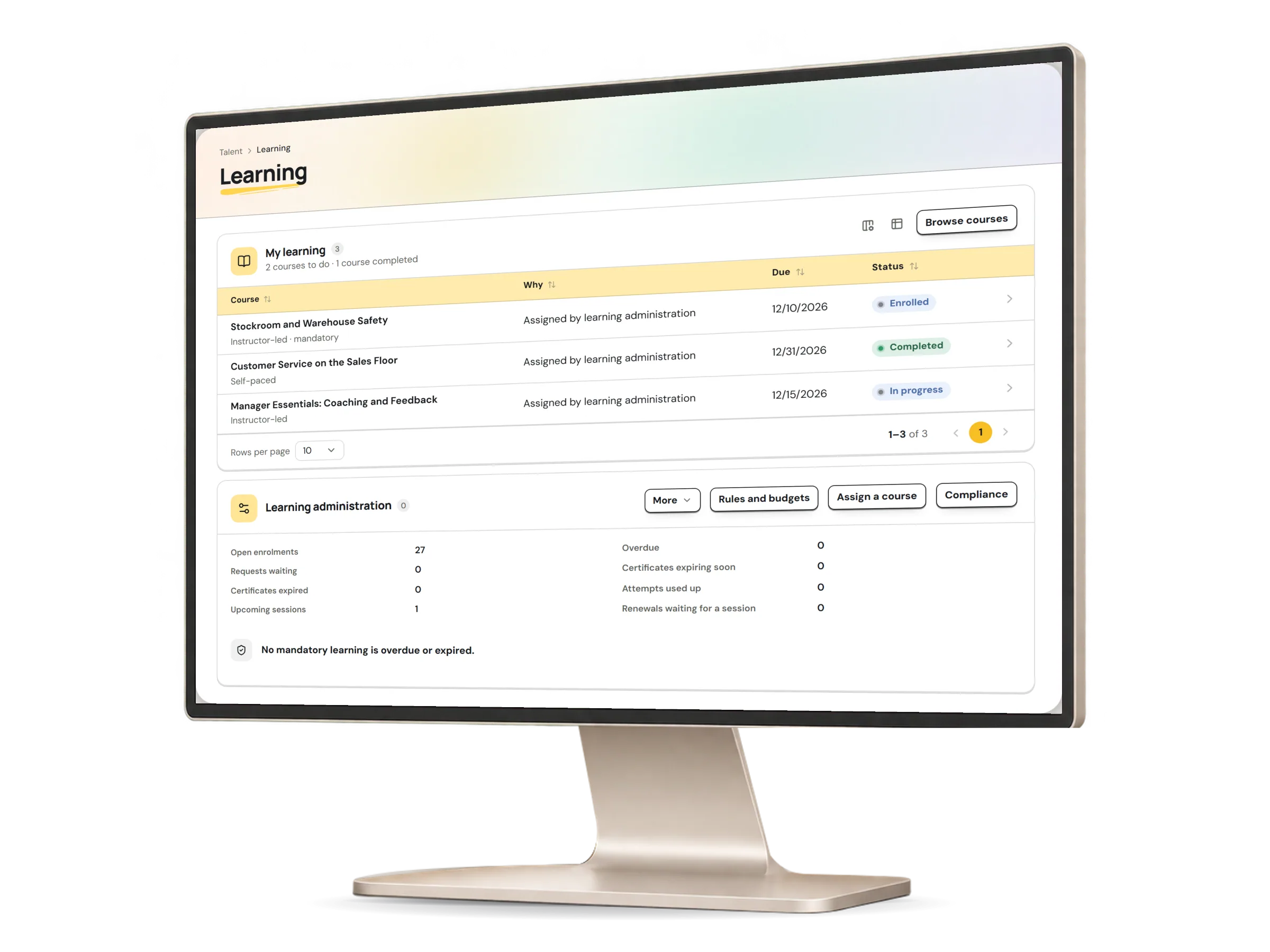
Included
- Course versions that stay fixed once published, with prerequisites, eligibility and a cost; a course can also point to content kept elsewhere: a link, a document or a provider's course code
- Learning paths that assign a set of courses together
- Enrollment by the learner, on request, by a manager or a learning administrator, or from a standing rule
- Completion by the learner's own confirmation, the trainer's attendance mark, a passed assessment, or evidence verified by someone other than the person who sent it
- Pre- and post-assessments drawn from question pools: single choice, multiple choice and true/false, with a pass mark and a limited number of attempts
- Instructor-led sessions with a trainer, seats and a waitlist; nobody is booked into two sessions at the same time, as a trainer or as a learner
- Rules that assign a course to everyone, one department or one job title, as mandatory or compliance learning with a due date
- Reminders in the app before the due date and while overdue, and the manager told once when mandatory learning is a week overdue
- Certificates tied to the completed course version, with any expiry the course sets, a renewal that opens before it lapses, revocation with a reason and a PDF download
- A compliance report of owed learning by course, department or location from your learning records, with an export
- Course costs and yearly learning budgets, per department where you set one
- Courses built from modules of text, link and quiz lessons, frozen with the version once it is published, with each learner's progress kept lesson by lesson
- Hosted video with captions and seeking; a video lesson completes once 95% is watched, and skipping ahead does not count
- Document lessons uploaded once per course, opened only by learning administrators and the people enrolled in it
- SCORM 1.2 and 2004 packages, imported and run in a sandboxed frame with their units offered in manifest order, and their status, score and time recorded
- xAPI packages with a basic learning record store, and cmi5 launch, where the package's own rule decides completion
- Lessons and packages that close once the enrollment is withdrawn or cancelled, or the learner has left
- A verification code on every certificate PDF, which anyone holding it can check on HumaRun's public certificate page
- Assignment rules that combine department, location, job title, legal entity, worker type and security role, with a new-hire window and due dates that can count from the start date
- Assignment rules that match a custom field; a sensitive field can never decide who is assigned
- A reminder window and the days overdue before the manager is told, set for each rule
- Virtual and hybrid sessions with a classroom link, and session times kept in the time zone they were set in
- Course requests and completion evidence decided in the Decision Inbox