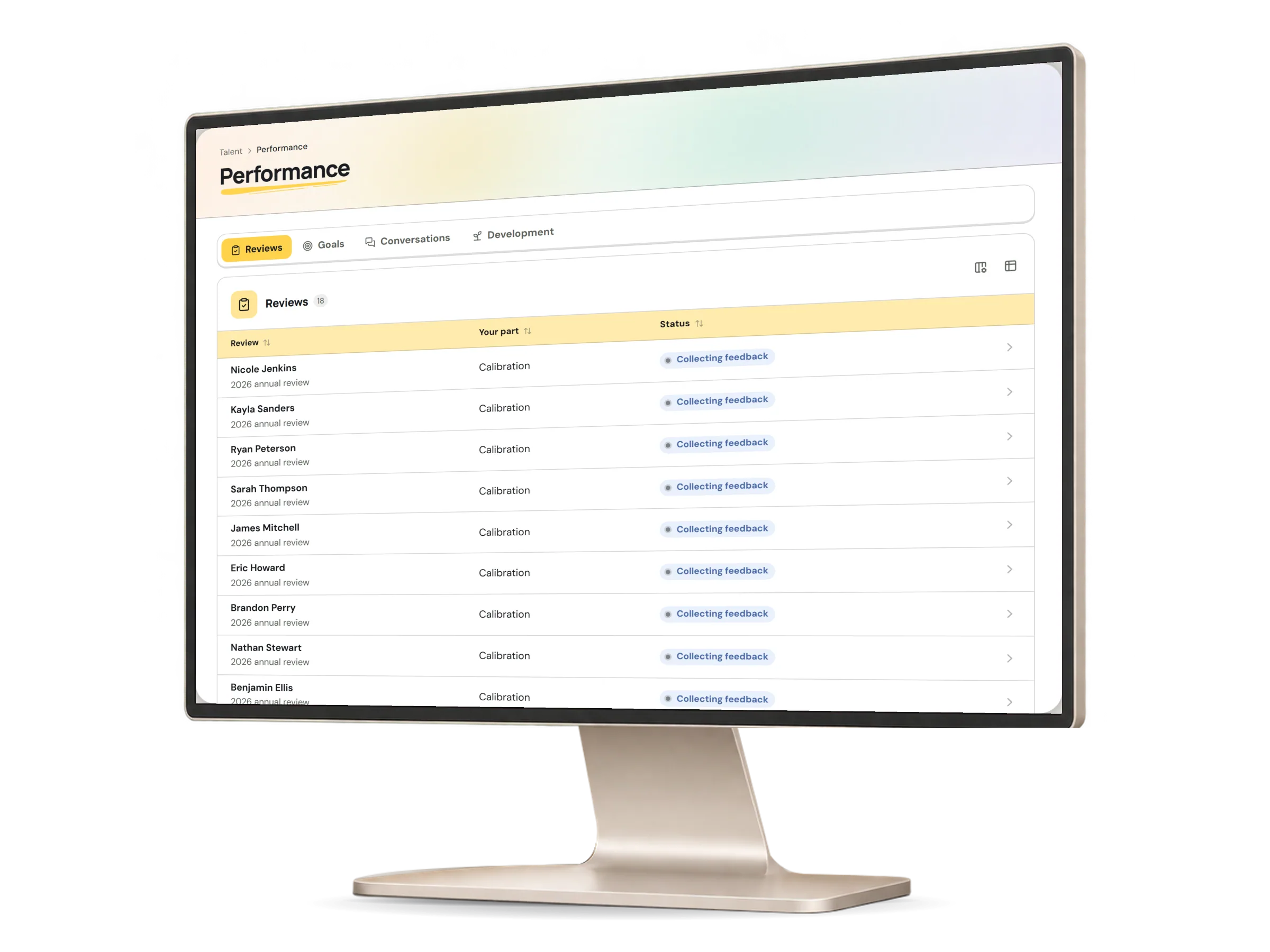
Included
- Individual, team and organization goals; an individual goal is agreed by a manager or HR, never by its owner, and a later change to its measure, target or date becomes a new version
- Weighted goal progress that counts only goals with recorded progress and shows how much of the weight that covers, never a missing measure as zero
- Check-ins: the employee writes, the manager adds notes, and the employee acknowledges them
- Review cycles from versioned templates, with rating, written, multiple-choice and goal questions and self, manager and peer inputs
- Peer feedback that others see only as an unattributed summary once at least three peers have answered, or more if your template asks; only HR with sensitive-data access sees who wrote what
- Final ratings entered by the manager and, where a cycle calibrates, adjusted by HR, then released for the employee to acknowledge or appeal, with every correction kept as a new release
- A calibration board for HR with sensitive-data access, with ratings before and after and every change kept with who and why; nobody calibrates their own review
- A released rating distribution for HR with organization-wide sensitive-data access, withheld while fewer than five people have a released rating
- Development actions, each with an optional course from your learning catalogue
- Key results on a goal, each owned by a current employee you can see, as a number, a percentage, an amount in one currency or done or not done, with check-ins and a confidence
- Goal progress rolled up from its key results by weight, showing how much of the weight has input
- 1:1 meetings seen only by the two people in them, with a shared agenda that carries open points forward, private notes only their author reads, and action items
- A versioned competency library linked to the jobs that expect each level, and competency questions in reviews
- Review eligibility rules, new hires added automatically while a cycle is open if you choose and only while the person who chose it keeps that authority, and in-app reminders before and after each due date
- A next-level sign-off before a review is released, and calibration changes approved by a second person, where a cycle asks for them
- A 9-box of current employees from each person's latest released rating and a recorded potential, shared with Succession; HR with sensitive-data access sees every box, a manager sees the boxes of people in their reporting line, and employees never see their own
- Improvement plans approved by someone in HR who did not write or submit them; an outcome never changes employment, pay or access
- Development plans with a focus competency and linked learning, signed off by someone other than the person who submitted them
- Review sign-offs, calibration changes, improvement plans and development plans decided in the Decision Inbox
- Ongoing feedback and feedback requests between colleagues, in words only, seen by the giver and the recipient, and by the recipient's manager only when the giver chooses
- Upward feedback from a manager's direct reports in a review cycle, shown only as a summary once at least three have answered, or more if your template asks, with no weight in the rating
- 1:1 meetings added to each person's own calendar from an .ics file